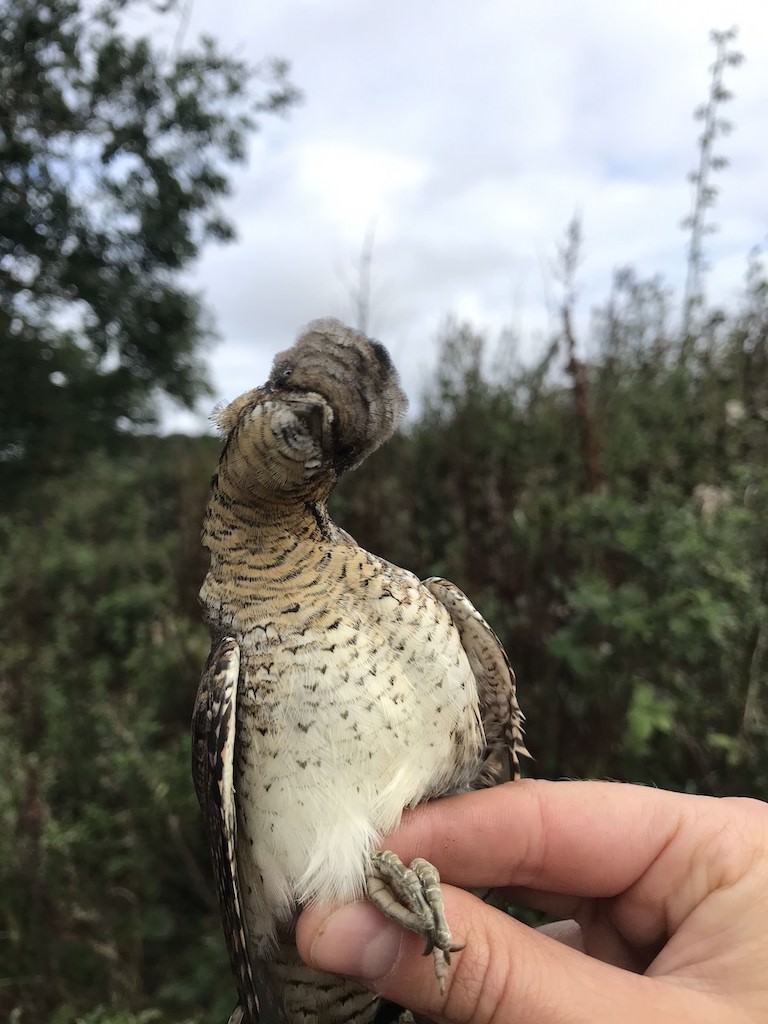
It was a slow start to our ringing session at South Landing, Flamborough. We put up 7 nets and only had a trickle of birds coming through during the morning. It was looking like it would be a slow and an uneventful session. As we sat outside to have some breakfast we heard a dog barking close to the nets. I decided to go and check it out in case anyone had wondered near our net lanes and to ensure any birds caught were safe. As I approached one of the mist nets, it suddenly dawned on me that something very unusual had been caught. I was extremely excited to see a wryneck (Jynx torquilla), which are small brown cryptic birds related to woodpeckers.
Wryneck distinctively moving its head.
These birds get their name from their ability to turn their heads almost 180 degrees. When disturbed, they use this snake-like head twisting to warn off predators. A wryneck has not been ringed in Flamborough since 1991 (28 years ago) and this was the 6th ever record ringed for the Observatory so a fantastic record.
An overcast and initially breezy day at South Landing which got off to a slow start with only a handful of birds in the first net round. A spell of showers forced the nets to be closed for a time. As the weather improved, flocks of swallows were flying around the site. Using a swallow tape lure caught us 2 swallows and interestingly 5 goldfinch. The next round saw another 13 goldfinches seemingly attracted by the swallow song being played. Another swallow and a further 6 goldfinches were caught, along with 3 chaffinch (an uncommon bird in our nets).
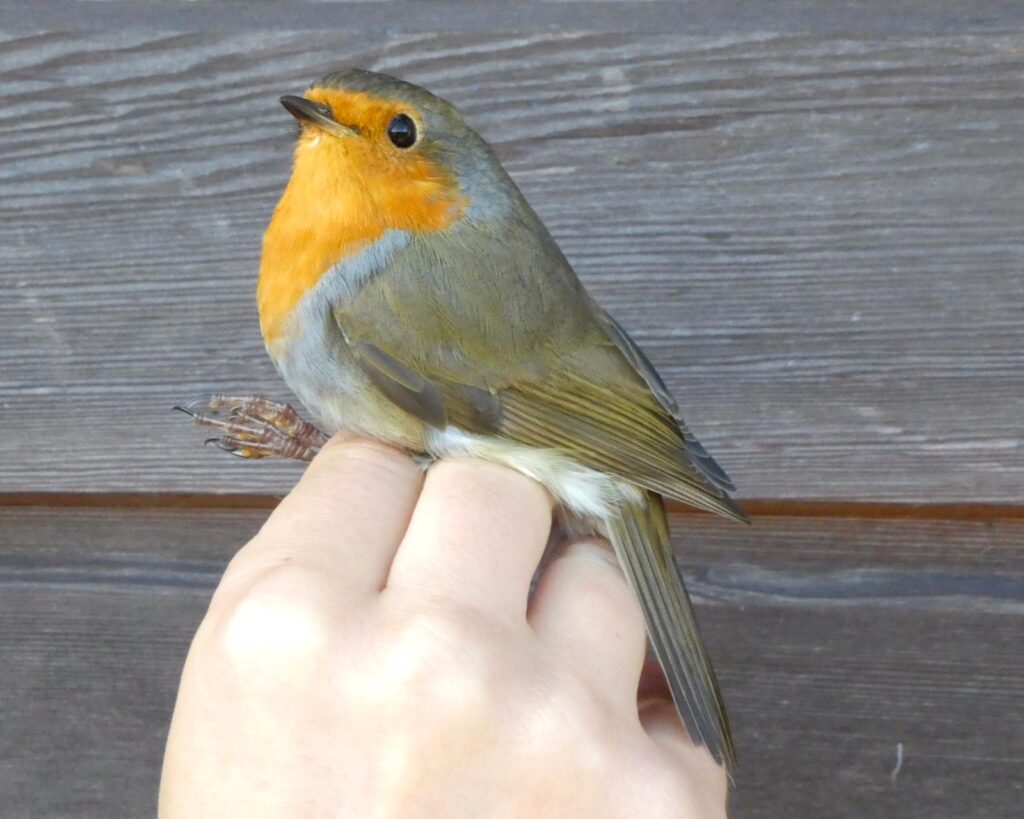
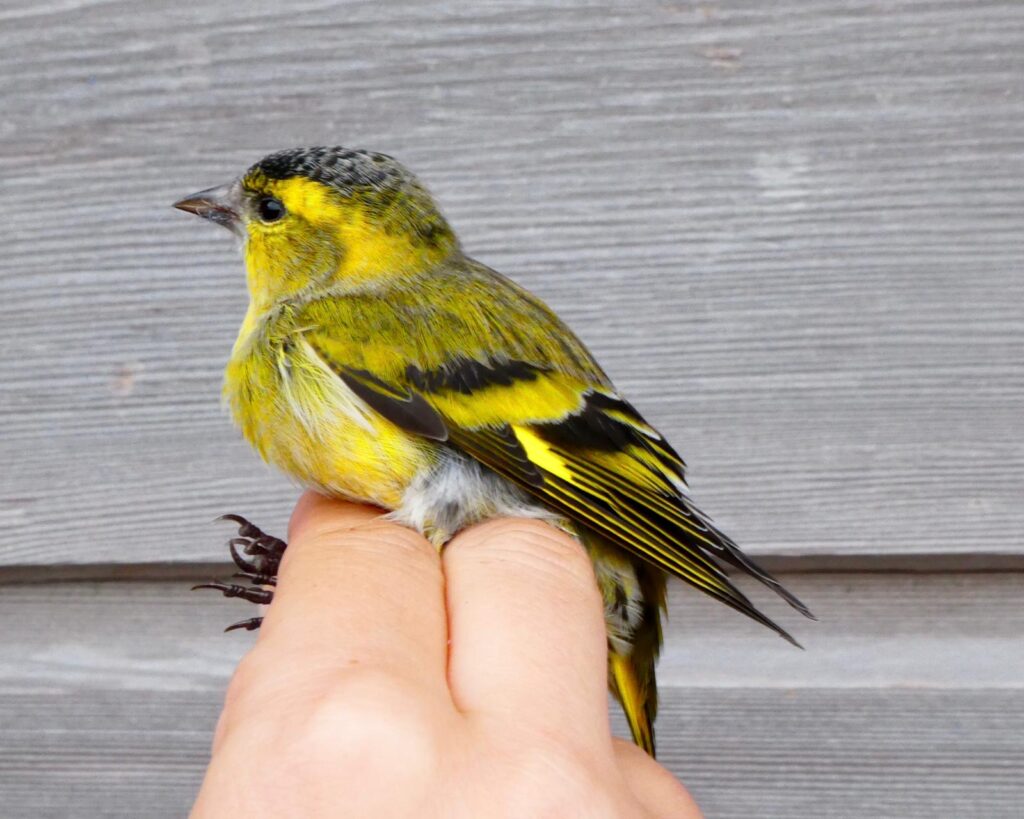
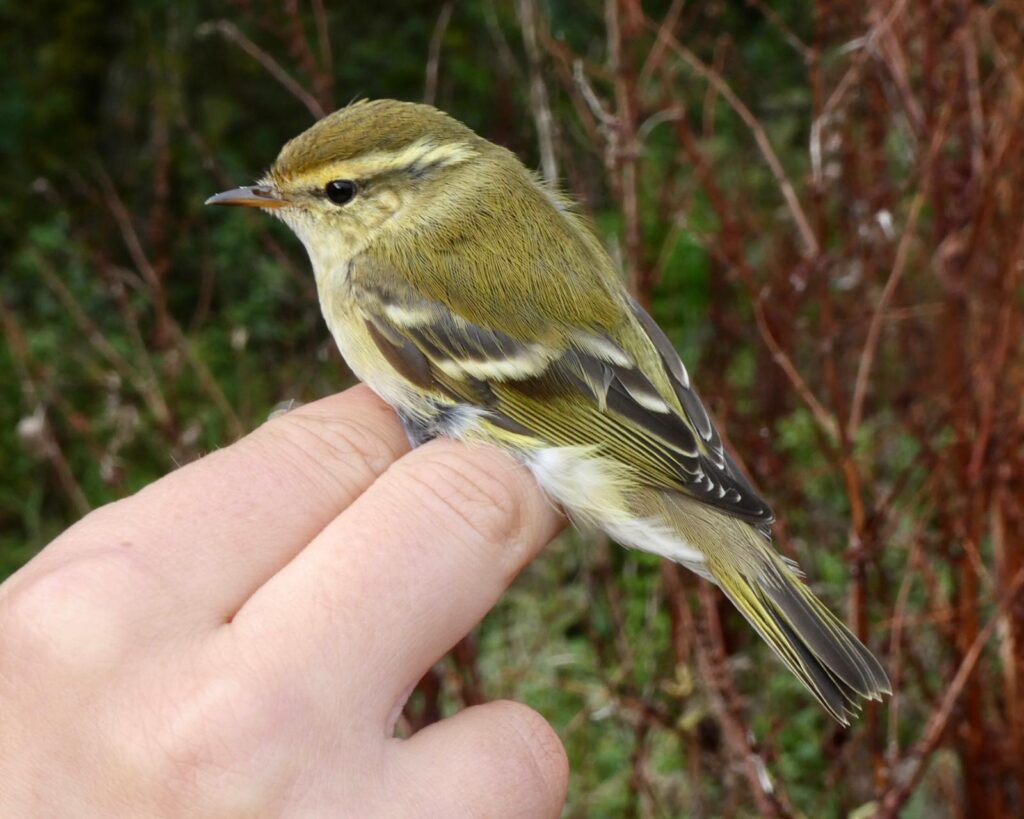
Looking at the weather forecast the night before, we weren’t sure whether it would be worth ringing in the morning. It was forecast to be a little gusty with occasional showers, but we decided to give it a go… you never know. We arrived at 6am and put up 7 nets at South Landing. After doing an initial net round, we knew we had made the right call and it was going to be a good day. Interestingly there was a large movement of robins with a total of 41 being caught throughout the morning. Other highlights were 5 yellow browed warblers and a lovely redstart. We also had a bonus bird at the end which was an adult siskin which we don’t often catch. We ended the session on 116 birds (96 new and 20 retraps). The lesson of the morning being sometimes the weather forecast is wrong!
As from the 1st January 2019 all of the bird ringing operating throughout the historical area east of the Dykes and also at Bempton is carried out by The Flamborough Bird Observatory (FBO) ringing group. Succeeding the now defunct East Yorkshire Ringing Group.
2019 was another year dominated by westerlies, denying us of even a modest period of easterlies in which to hope for numbers of grounded migrants. We had some 15 registered ringers and trainees active at various times during the year in addition to a few visiting ringers. In the twelve month period there were 105 different ringing sessions during 82 days of ringing activity at our main headland ringing sites. We also benefited from regular trapping and ringing in Paul and Jenny Butterworth’s garden and at Andy Hood’s residence, Ocean View, where the two sites amassed over 30% of the total birds ringed. The importance of South Landing as our prime ringing and demonstration site was again in evidence, accounting for almost 40% of all birds ringed.
Another record breaking year on the Outer Head !
3348 birds of 65 species which has comfortably passed last year’s record breaking Flamborough year of 2938 birds of 61 species. We have now logged this as the 6th year in succession to record a year on year increase in ringing totals. New additions to the species list were; Nuthatch, two birds were caught and ringed in South Dykes in March after taking up residency for several months and Cetti’s Warbler on 22nd April and 27th September. It will be interesting to see whether Nuthatch establishes itself in the wooded areas and whether further sightings of this species are of ringed birds.
The top 5 species ringed east of the dykes during 2018 were: Starling 464, Goldcrest 268, Blackbird 232, Blue Tit 224 and Robin 175. The ringing of migrant warblers has also continued to see increase. 434 migrant warblers ringed surpassed last year’s highest ever total at Flamborough by a margin of well over 100 birds. Lesser Whitethroat (20), Whitethroat (54) and Willow Warbler (38) maintained their healthy totals of 2018 and the Icterine and Wood Warblers were the first to be ringed since the inception of the Bird Observatory in 2002. The Blackcap (150) and Chiffchaff (136) totals were both approximately twice their previous highest year totals!
The two most productive months were as usual September and October together accounting for 47% of all new birds ringed, nets being set on 15 days during each month. The three best days’ ringing totals of 177, 158 and 146 were all achieved during the Ringing and Migration Week (October 12th – 20th) held in conjunction with our friends at Filey Bird Observatory. That week returned 728 birds ringed at Flamborough of 33 species, with birds caught and ringed on all 9 days, a sterling effort from all concerned, despite not having the best of weather.
Ringing highlights of 2019, apart from the two new species already mentioned above would include Tree Pipit, the Icterine Warbler (the 20th to be ringed at Flamborough and the first since 1997), a Wood Warbler (the 15th for Flamborough and the first this century) and 5 Yellow-browed Warbler (somewhat disappointing after the previous two years). The number of Goldfinch (112) ringed was again the highest year total since the Observatory was founded, whereas Lesser Redpoll were noticeable by their absence – a meagre 4 individuals caught during the whole of the autumn.
Bird ringing to the west of the Dykes was carried out at Bempton and Buckton.
2019 marked the first full calendar year of ringing activities at Bempton Cliffs, which included the running of a whoosh net in a Bempton village garden. Between the two sites a combined total of 1490 new birds of 44 species were ringed from 51 ringing sessions during the 12-month period.
The top five species ringed were Tree Sparrow 519, Starling 100, Goldcrest 72, Wren 65, and Robin 58. A Tree Sparrow nest record scheme project was continued for a third consecutive year where a remarkable 296 nestlings were ringed from nest boxes. Furthermore, 223 full grown birds were also ringed over the course of the year. Star birds were Pallas’s Warbler, Siberian, tristis race of Chiffchaff, Barred Warbler and a Yellow-browed Warbler.
In addition to the above mentioned, all ringing efforts for the Flamborough Bird observatory were supported by David Aitken, Phil Bone, Tony Corscadden, Ana Cowie, Jacob Davies, Jo Hood, Imogen Lloyd, Lucas Mander, Julia Wildi, Ian Marshall, Jim Morgan, John McEachen, Steve Westerberg, Tina Wiffen, Elliot Morley, Josh Saunders, Saskia Wischnewski, Sara Miller, Andy Jayes, Harriet Day, Michael Babcock and Will Scott.
At Buckton during 2019 a total of 1102 new birds were ringed by Mark Thomas, Ed Green, Dave Aitken and Richard Hearn. This represents the third highest total in the last 19 years. Highest species totals were Tree sparrow (147), Redwing (142), Yellowhammer (77), Robin (70) and Reed Bunting (67). Good numbers of buntings were attracted to seed and caught in the early part of the winter but following this, spring migration was rather disappointing. The breeding season was good with juvenile Kestrels, Barn Owls, Stock Doves, Swallows and Tree Sparrows all ringed. Autumn migration never really peaked although combined thrush numbers were excellent including three Ring Ouzel. Two Yellow-browed Warblers were caught along with four Siberian Lesser Whitethroats – all confirmed by DNA analysis.
There have been 27 reported movements of birds to or from Flamborough Head during 2019. The highlights being; Goldcrest from Flamborough to Norway and from Buckton to The Netherlands and Lesser Whitethroat from Belgium to Flamborough and from Buckton to Belgium.
Another day of north easterlies forecast and I was optimistic about the session ahead. The quagmire-like conditions created by the resident cattle at Holmes Gut made setting up a little bit more demanding, but our first round delivered a good number of birds; mainly consisting of early morning thrushes which were pretty abundant around the site. The morning continued steadily as a slight rain-front threatened to halt our progress. The rain came and went after about fifteen minutes, and I wondered if this could have brought in something interesting when Jim mentioned that it may have done so. There I was becoming excited over the possibility of a fieldfare, or even better, ring ouzel, when it was revealed as something (in my opinion) that is almost impossible to top; a stunning Woodcock! An absolute cryptic beauty, my first time seeing one in the hand, and another memorable Migweek moment!
Hello everyone and a great big thanks to all of the participants who took part in our most successful Ringing & Migration Week (Migweek) to date: Dave Aitken, Paul & Jenny Butterworth, Tony Corscadden, Ana Cowie, Harriett Day, Andy Hood, Jo Hood, Andy Jayes, Jamie Johnson, Jarred Johnson (no relation), Imogen Lloyd, Lucas Mander, Ian Marshall, Poppy Rummery and Josh Saunders. Thanks also to Tony Hood for being very helpful and talking to the public!
A grand total of 1214 new birds of 38 species were ringed, from 6 different ringing sites on the headland. We caught no rare birds but we did have a few highlights; a couple of Sparrowhawks, Woodcock, Ring Ouzel, 2 ‘tristis’ Chiffchaffs, 5 Fieldfare and pride of place must go to the Norwegian-ringed Goldcrest trapped at Bempton.
The greatest achievement must surely be the Redwing total of 220 birds, this has more than doubled the existing FBO annual record! ….. and we still have another few weeks of autumn remaining. Many thanks to all involved, now we can await some great recoveries.
Jim Morgan – Flamborough Bird Observatory Ringer In Chief
p.s. a ‘warming-down session on Monday at South Landing produced 2 foreign-ringed Goldcrest from Norway and Finland!
Bird ringing brings joy and excitement and for me ,this weekend, is exactly what it did at Flamborough Bird Observatory as well as Bempton cliffs. Two fantastic places where I have met incredible, knowledgeable people with the same passion as me. They dedicate their time and hard work to Flamborough Bird Observatory.
I was fortunate to be a part of this the last couple of days. I was invited over to do some ringing, which is brilliant as I am keen to ring other birds and meet people with the same passion as me.
Back home I am part of a ringing group called Sorby Brecks based in Sheffield where I am a trainee, working towards my c license. So meeting other ringers and new birds is a perfect opportunity, which Flamborough Bird Observatory offers especially over migration week. You never know what might turn up. The early mornings paid off on my last day of ringing at Flamborough, we happened to extract two goldcrests, one wearing a Norwegian ring and the other wearing a ring from Finland. For me that’s what ringing is all about.
However all of Flamborough head through to Bempton gives you a good opportunity of seeing some stunning birds. My highlight of this weekend was seeing the red flanked bluetail, wow it really is amazing, such rarity’s turning up in Flamborough. So thank you for my extraordinary weekend with you all and how welcome you made me feel.
Harriet Day
Thank you Jo Hood, Jim Morgan, Dave Aitken & Imogen Lloyd
A sunny start soon gave way to an overcast and breezy morning. We put up 7 nets, hopeful as Brambling and Siskin were flying over and calling. Sadly no Brambling or Siskin to be caught today or any of the lovely flock of 30 Fieldfare that flew over us. We had a very quiet morning with 21 birds caught however we did catch a nice mix of birds including 5 Goldcrests and a Chiffchaff, most likely migrants passing through. We also caught 4 Tree Sparrows, a species we are privileged to have thriving on the headland given there are some counties were it is in effect extinct. The gentle pace gave us chance to photograph some of the feather characteristics we look for when ageing birds.
A last session before lockdown saw us out on a sunny and crisp morning, with skeins of Pink-footed geese flying overhead.
We had a very steady morning and caught 10 new birds alongside 8 retraps. We were lucky enough to catch 2 beautiful Grey Wagtails, whilst we often see Grey Wagtails on the beaches at South landing and Danes dyke we rarely catch them, they also pass over the headland at this time of year on migration. We also caught a juvenile male Sparrowhawk and 2 Goldcrests.
Hopefully we will be able to get back out ringing soon.
With limited ringing opportunities due to the unsettled weather, we took a lockdown friendly walk around South Dykes. As the wind dropped and the afternoon sun came out we saw plenty of birds including flocks of mixed titmice, a handful of foraging Goldcrest and at least 60 Chaffinch feeding along the field margins with a few Greenfinch and Yellowhammer mixed in.
The highlight however was seeing a male Nuthatch that we had originally ringed on the 20th March 2019, we were able to read the ring from numerous photos taken of the bird. We caught both a male and female Nuthatch on the 20th March 2019. They were sexed by colour of the flanks and under tail coverts, which are a brighter rufous-red and well demarcated from the whitish or buff lower throat, belly and breast in the males.
Both birds were aged as 2nd year birds (born in 2018), based on contrast in the median and greater covert feathers. These 2 birds were the first Nuthatches to be ringed in the observatory recording area, up until this point they were a very scare visitor to the headland. A pair were initially seen in the South Dykes area from October 2017, with nesting recorded the following year and in June 2019 3 birds were recorded in the same area.
This morning we had the recently rare occurrence of 3 sites being ringed at simultaneously at Flamborough. One ringer was at their private site on the Headland, 2 ringers were at Holmes Gut and 2 at South Landing (all under current BTO guidance). It was a cold and slow start with some birds trickling through, but a great perk of getting up so early is seeing the sunrise! At South Landing we caught more retraps than birds without rings which is still valuable information. The highlights for us were a lesser redpoll, a chiffchaff and 2 tree sparrows.
Whilst we were doing our net rounds, we were dismayed to see the amount of litter that had been left at South Landing, including items such as plastic visors. Please remember to always take your rubbish home with you or dispose of it appropriately. Litter can have a detrimental impact to our wildlife which more and more people are appreciating at the moment during the current lockdown.
A still and overcast morning with lots of Blackbirds calling from the hedges saw us open 9 nets, hopeful for the catch ahead.
We put up a net in a new ride only recently cut, as we were putting up the nets we flushed at least 4 Woodcock from the scrub, the last few days have seen a noticeable arrival of these beautiful birds.
The first net round saw the new ride deliver a wonderful treat- a Woodcock, these medium sized waders have an amazing cryptic plumage designed to help camouflage them in their woodland habitat. They are generally a secretive bird, often only seen at dusk or dawn when they feed in woodland floors or damp fields. In spring males can sometimes be seen giving display flights, ‘roding’ and making their distinctive croaking call.
The Woodcock was the definite highlight of the session, alongside 15 Blackbirds, 3 gorgeous male Bullfinch and a Treecreeper.
This year the FBO ringing team have embarked on an exciting new trial. We have established a Constant Effort Site at Thornwick, which is a scheme run by the British Trust of Ornithology, identifying changes in catch sizes across a network of standardised mist nets. This enables us to better monitor changes in the abundance and breeding success of common passerines.
At Thornwick, licensed ringers will erect a series of mist nets in the same positions, for the same amount of time, during 12 visits evenly spaced between 1 May and 31 August.
CES ringing station
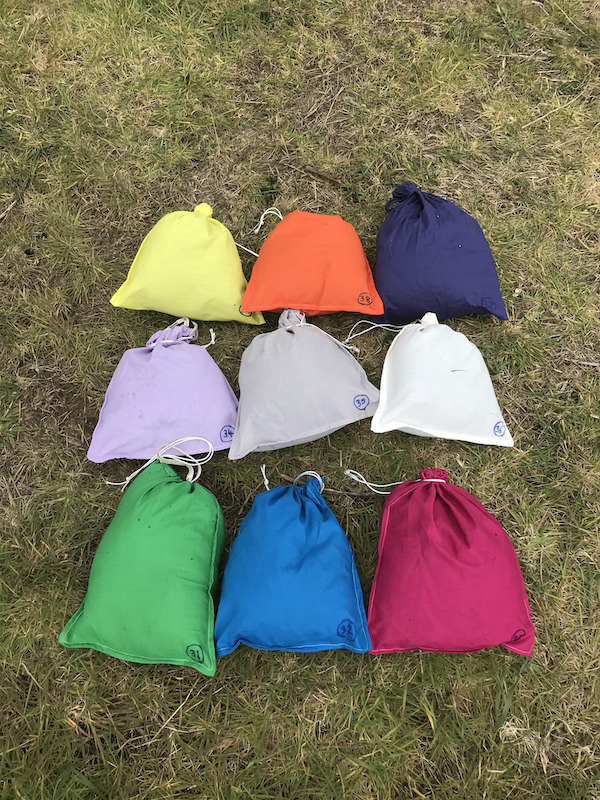
CES bird bags
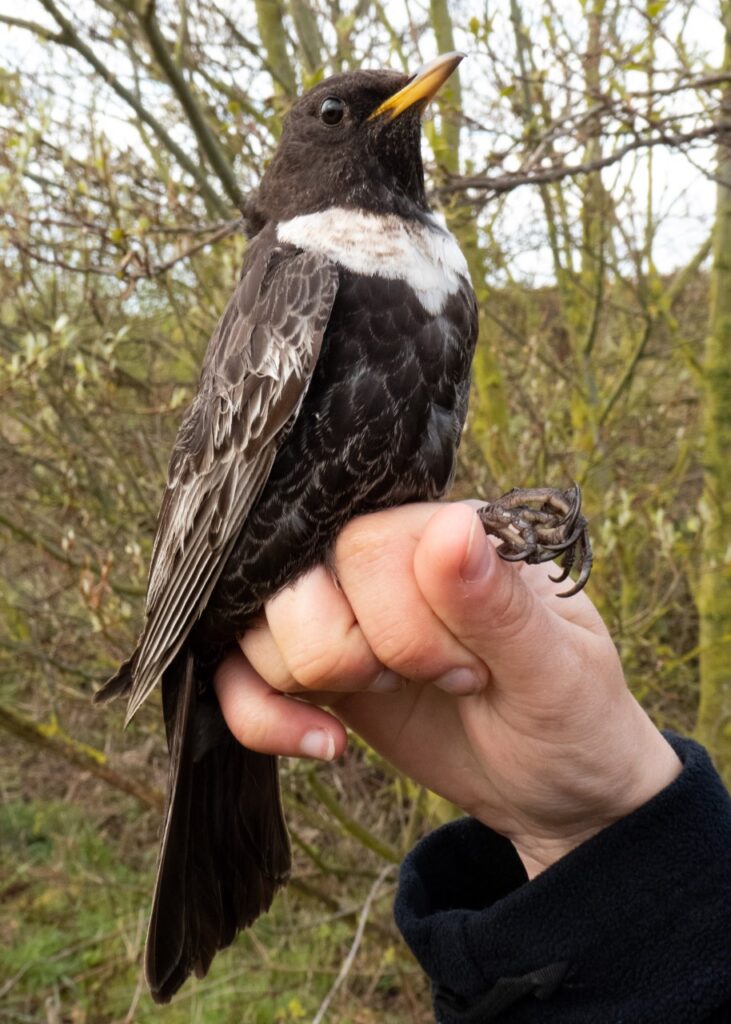
This morning was the first session of the scheme and we couldn’t have asked for a better start… It was a cold and frosty morning to begin with, with small amounts of rain falling. We started with a few chiffchaffs, whitethroats, lesser whitethroats and more trickling through but the star bird came a bit later and was completely unexpected. As we approached one of the nets, all of us saw a blackbird sitting calmly, however as we got closer some white peaked through and to our amazement, it was a stunning ring ouzel! Two of the ringers present had never seen one in the hand before so this was a real treat.
CES nets
Ring ouzel ringed at Thornwick
We ended the session with 25 newly ringed birds, 13 recaptures and 17 species in total.
The change in wind direction and the arrival of many migrants over previous days was an optimistic sign for our ringing session at South Landing. We arrived on site at 05.30 am, having had a quick stop to admire the Hoopoe on the nearby bowling green, a beautiful sunny morning with barely any wind and plenty of birdsong greeted us.
We initially erected 7 nets, later adding another 2, the first net round delivered on the migrant front with 2 Lesser Whitethroats, one of which was a returning bird having been ringed as a juvenile at Flamborough last year. Also in the first round was a lovely Sedge Warbler, the first time we’ve caught one in spring at this site. Throughout the session we had a steady stream of Warblers, in fact 6 different species were caught, including a Garden Warbler and 7 Blackcaps.
It was rewarding to re-catch 5 Warblers previously ringed at Flamborough, its nice to know they have survived their migration and made it back to raise another generation. We had another special bird – a Reed Warbler, another first spring catch at this site. Alongside our migrants we also caught some resident birds showing brood patches, evidence they are breeding locally, including Blackbirds, Dunnocks, a Coal Tit, Bullfinch and Song Thrush.
A lovely spring session lasting 6 hours in which we caught 35 birds of 17 species.
Today we had a successful second CES (Constant Effort Site) ringing session at Thornwick. When we arrived the weather conditions were ideal with an overcast sky and no wind which make the nets less visible to birds. We got our 9 standard nets up in a quick 30 minutes so had time for a quick tea and biscuit break. It was a steady session with a larger than average number of whitethroats (6) and lesser whitethroats (3) caught.
There were a nice variety of birds with 14 species caught in total (26 newly ringed and 9 retraps).
We are looking forward to finding out valuable trend information on abundance of adults and juveniles, productivity and also adult survival rates through this national scheme.
An overall fairly quiet morning at Thornwick, with a slightly busier start and finish to the session contradicting a comparative lull mid-morning, though morale was boosted by a greasy breakfast sandwich and a bit of sunshine at the midway point! Despite a lot of retraps, we had a good variety of birds for the morning, with a couple of new Lesser Whitethroat and single Reed Warbler the highlights. A recently fledged Dunnock also provided us with an element of cuteness to take away.
Sunday 13 June was our 4th of 12 Constant Effort Site (CES) sessions run by Ana Cowie and Tony Corscadden and assisted by Sophie Bennet and Saskia Wischnewski, RSPB seabird scientists. 7 new birds were caught: 1 bullfinch, 1 chiffchaff, 1 reed bunting, 1 sedge warbler, 2 whitethroat and 1 yellowhammer plus 7 retraps: 1 sedge warbler, 2 whitethroat, 3 willow warbler and 1 wren. The grand total of 14 birds was low but weather affected by the mostly hot, sunny and windless conditions. Subsequent sessions will be busier as fledglings become active.
The bird featured is a female reed bunting (Emberiza schoeniclus) age code 5 i.e. 2nd calendar year. In autumn 2020 it performed a typical post-juvenile moult of body feathers, lesser, median and all greater coverts and, normally, all tail feathers, though this bird has retained its central pair. The adult type denser, glossier, darker coloured greater coverts and tertials contrast with the paler and worn juvenile flight feathers, primary coverts and alula feathers.
Our eighth CES session today caught 28 new birds (and 2 retraps) and was dominated by warblers, making up 64% of the catch, and though most were juveniles we were still able to compare some adult with juvenile plumages.
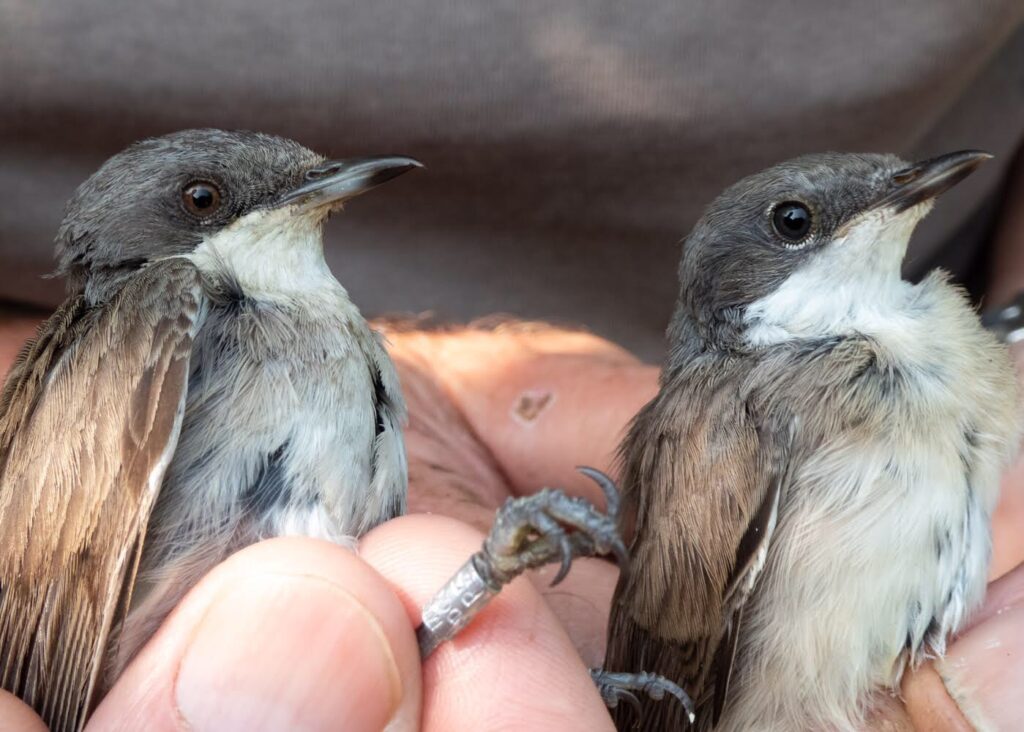
Photo 1 shows two lesser whitethroats: the iris of the adult on the left is hazel and shows a (just visible in the photo) whitish crescent above the pupil whilst the iris of the juvenile on the right is uniform dark grey.
Photo 1
Photo 2
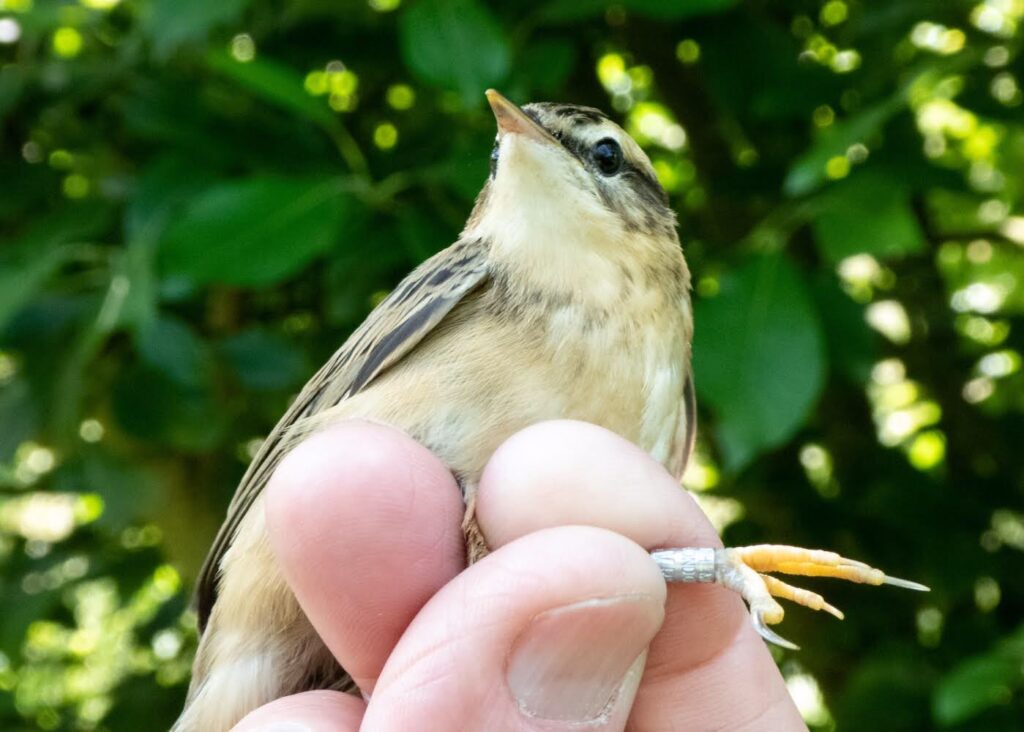
Photo 3
Adult lesser whitethroats complete their full annual moult after breeding and before migrating back to Africa and so are very worn at this time of year, recently fledged juveniles have fresh plumage as shown by the comparison of the two tails in photo 2.
Adult sedge warblers complete their full annual moult on their African wintering grounds and so are quite worn by July compared to fresher juveniles. Juveniles can also by told by the dark brown speckling on the breast which forms a ‘gorget’ (see photo 3) whilst adults have an unstreaked breast.
Our first full session at South Landing since May saw us put up 7 nets at 5.15am, the early morning drizzle had luckily stopped by then, and the morning was still and overcast.
We had nets up till 10.45am by which time it was warm and sunny, with a steady catch every net round.
We had a successful morning catching 65 birds of which 57 were new.
Of the 20 species caught it was really rewarding to catch 13 juvenile Common Whitethroat, as well as 2 juvenile Great spotted woodpeckers.
A number of the warblers we caught were adults who’d already began their post breeding moults, this gave the trainees a good opportunity to practise ‘scoring’ the individual flight feathers for the stage of moult, just one of the many pieces of data collected by the ringers and collated by the British Trust for Ornithology.
A total of 20 different species were ringed in the session.
Our ninth CES session at Thornwick saw a mild morning, with periods of sunshine and a gentle breeze.
A steady start, followed by a few very quiet net rounds was followed by a flurry of activity! We caught a mixed flock of Long-tailed tits, Blue tits, Willow Warblers and a Lesser Whitethroat.
It was rewarding to ring 4 juvenile Reed Warblers, most likely out of nests at the nearby Thornwick pools.
A total of 33 birds of 14 species caught, of which 23 were new birds and 10 re-traps of birds previously ringed. Re-traps provide valuable data on longevity of adults, and it is always nice to see birds return to their breeding grounds after surviving migration.
Only 4 of the birds caught were adults with all the rest being juveniles fledged this year. Pictured are a juvenile Blackcap and a juvenile Chiffchaff, showing the duller and fluffier, looser textured feathers of young birds compared to adults.
The Flamborough Bird Observatory (FBO) ringing group comprises the historical recording area east of the Dykes on Flamborough Headland together with operations at Bempton, mainly at Bempton Cliffs RSPB Reserve. The purpose of the ringing group is to gather data on wild birds, especially migrants, which are found in the FBO area. The secondary purpose is to assist in the training of people in the techniques of trapping, handling and ringing wild birds.
The ringing programme was severely interrupted by the Covid lock-down, meaning that people were not allowed to travel from their homes to ring birds and as a result there was no ringing on our public headland sites for a period of over 3 months, from march through to July. Fortunately, we have resident ringers Paul & Jenny Butterworth, in the village and Andy Hood out at Ocean View, who kept the totals ticking over throughout the year and this really made the difference with the two sites accounting for 53% of all birds ringed. South Landing (32%) and Thornwick Bay (9%) accounted for the bulk of the remainder. Holmes Gut (3.5%) proved to be more difficult to work because of the presence of highland cattle for much of the year, despite the low total it still remains one of our important ringing sites on the headland. Offsetting that somewhat was the development of a new ringing site in the scrub near the entrance to Thornwick Bay Holiday Village. This site seems to have good potential and it is hoped that we can register this with The British Trust for Ornithology as a CES (constant effort site). The CES scheme is a national standardised ringing programme which helps provide valuable trend information on abundance of adults and juveniles, productivity and also adult survival rates for species of common songbird.
Once more, another record-breaking year on the outer head! 4626 birds of 67 species which has more than comfortably passed last year’s record breaking Flamborough year of 3348 birds of 65 species. We have now logged this as the 7th year in succession to record a year-on-year increase in ringing totals and the third year on the bounce that we have achieved a new Flamborough record. New addition to the species list was a Kingfisher caught at Ocean View in June, the very first to be ringed in the FBO area. Other highlights were a Common Crossbill, caught in July, also at Ocean View, which is the first to be caught since the formation of the bird observatory and also the first Grasshopper Warbler for 10 years. A breakdown of birds ringed by month is given in the table below:
The Flamborough Bird Observatory (FBO) ringing group comprises the historical recording area east of the Dykes on Flamborough Headland together with operations at Bempton, mainly at Bempton Cliffs RSPB Reserve. The purpose of the ringing group is to gather data on wild birds, especially migrants, which are found in the FBO area. The secondary purpose is to assist in the training of people in the techniques of trapping, handling and ringing wild birds.
The ringing programme was severely interrupted by the Covid lock-down, meaning that people were not allowed to travel from their homes to ring birds and as a result there was no ringing on our public headland sites for a period of over 3 months, from march through to July. Fortunately, we have resident ringers Paul & Jenny Butterworth, in the village and Andy Hood out at Ocean View, who kept the totals ticking over throughout the year and this really made the difference with the two sites accounting for 53% of all birds ringed. South Landing (32%) and Thornwick Bay (9%) accounted for the bulk of the remainder. Holmes Gut (3.5%) proved to be more difficult to work because of the presence of highland cattle for much of the year, despite the low total it still remains one of our important ringing sites on the headland. Offsetting that somewhat was the development of a new ringing site in the scrub near the entrance to Thornwick Bay Holiday Village. This site seems to have good potential and it is hoped that we can register this with The British Trust for Ornithology as a CES (constant effort site). The CES scheme is a national standardised ringing programme which helps provide valuable trend information on abundance of adults and juveniles, productivity and also adult survival rates for species of common songbird.
Once more, another record-breaking year on the outer head! 4626 birds of 67 species which has more than comfortably passed last year’s record breaking Flamborough year of 3348 birds of 65 species. We have now logged this as the 7th year in succession to record a year-on-year increase in ringing totals and the third year on the bounce that we have achieved a new Flamborough record. New addition to the species list was a Kingfisher caught at Ocean View in June, the very first to be ringed in the FBO area. Other highlights were a Common Crossbill, caught in July, also at Ocean View, which is the first to be caught since the formation of the bird observatory and also the first Grasshopper Warbler for 10 years. A breakdown of birds ringed by month is given in the table below:
The Flamborough Bird Observatory (FBO) ringing group comprises the historical recording area east of the Dykes on Flamborough Headland together with operations at Bempton, mainly at Bempton Cliffs RSPB Reserve. The purpose of the ringing group is to gather data on wild birds, especially migrants, which are found in the FBO area. The secondary purpose is to assist in the training of people in the techniques of trapping, handling and ringing wild birds.
The ringing programme was severely interrupted by the Covid lock-down, meaning that people were not allowed to travel from their homes to ring birds and as a result there was no ringing on our public headland sites for a period of over 3 months, from march through to July. Fortunately, we have resident ringers Paul & Jenny Butterworth, in the village and Andy Hood out at Ocean View, who kept the totals ticking over throughout the year and this really made the difference with the two sites accounting for 53% of all birds ringed. South Landing (32%) and Thornwick Bay (9%) accounted for the bulk of the remainder. Holmes Gut (3.5%) proved to be more difficult to work because of the presence of highland cattle for much of the year, despite the low total it still remains one of our important ringing sites on the headland. Offsetting that somewhat was the development of a new ringing site in the scrub near the entrance to Thornwick Bay Holiday Village. This site seems to have good potential and it is hoped that we can register this with The British Trust for Ornithology as a CES (constant effort site). The CES scheme is a national standardised ringing programme which helps provide valuable trend information on abundance of adults and juveniles, productivity and also adult survival rates for species of common songbird.
Once more, another record-breaking year on the outer head! 4626 birds of 67 species which has more than comfortably passed last year’s record breaking Flamborough year of 3348 birds of 65 species. We have now logged this as the 7th year in succession to record a year-on-year increase in ringing totals and the third year on the bounce that we have achieved a new Flamborough record. New addition to the species list was a Kingfisher caught at Ocean View in June, the very first to be ringed in the FBO area. Other highlights were a Common Crossbill, caught in July, also at Ocean View, which is the first to be caught since the formation of the bird observatory and also the first Grasshopper Warbler for 10 years. A breakdown of birds ringed by month is given in the table below:
Jan
Feb
Mar
Apr
May
Jun
Jul
Aug
Sep
Oct
Nov
Dec
36
35
88
174
114
348
661
542
786
1289
422
131
As is the norm, the bulk of our totals are achieved throughout the autumn months, with Aug/Sep/Oct comfortably exceeding 50% of all birds caught. Our annual celebration of migration – Migweek – from the 10th to the 18th October was a resounding success, despite the lack of public involvement due to Covid restrictions. Nets were successfully erected on all 9 days, which in itself is unusual with the October weather and an impressive 1200+ birds were ringed by the group, 963 on the outer head and 251 at Bempton Cliffs RSPB. A sterling effort by all involved! We experienced our best autumn season for catching Meadow Pipits aided by the use of mp3. lures, mainly at South Landing and Ocean View. Virtually all birds ringed were between the 31st. August and 22nd. September when nets were deployed on 16 occasions. The total ringed on the outer head was 220, another highest total since the inception of the bird observatory. Our Redwing totals (259) again surpassed any previous year. October, as always, was the peak month for this species, returning our best catches on the 13th/14th, when an unprecedented 71 and 51 birds respectively were caught and ringed.
The top 5 species ringed east of the dykes during 2020 were all migrants or partial migrants, namely: Starling (613), Blackbird (577), Goldcrest (278), Redwing (259) and Tree Sparrow (235). Meadow Pipit came a close sixth! As was the case last year, the ringing of migrant warblers has also continued to see increase. 588 migrant warblers ringed surpassed last year’s highest ever total at Flamborough by a margin of almost 150 birds. We achieved the highest totals ever for six species of warbler; Reed Warbler (17), Lesser Whitethroat (27), Whitethroat (67), Blackcap (181), Yellow-browed Warbler (20) and Willow Warbler (123). The Willow Warbler total is particularly gratifying as it is a species that seems to turn up in ever-decreasing numbers – may 2021 continue this upward trend!
We had some 16 registered ringers and trainees active at various times during the year in addition to a few visiting ringers. My thanks to the following for keeping the Observatory ringing group going: Dave Aitken, Paul & Jenny Butterworth, Tony Corscadden, Ana Cowie, Andy Hood, Jo Hood, Andy Jayes, Jamie Johnson, Jarred Johnson, Imogen Lloyd, Lucas Mander, Ian Marshall, Elliot Morley and Josh Saunders. In the twelve-month period, in addition to the garden ringing, we completed 75 different ringing sessions at our main headland ringing sites; South Landing, Holmes Gut, Thornwick Bay and Old Fall, which was a considerable achievement considering the ringing year comprised less than 9 months.
The three best days’ ringing totals on the outer head were 145 (28/9), 166 (13/10) and 216 (14/10), the latter two achieved during the MigWeek (October 10th – 18th). Ringing highlights of 2020, apart from species already mentioned above would include Wryneck (the 6th one to be ringed on Flamborough Head, but the first one for over 30 years!), Tree Pipit and Wood Warbler (the 16th for Flamborough) for the second year running after a gap of almost 20 years. The aforementioned three species all caught at South Landing. The number of Goldfinch (215) continues its recent increase, again the highest year total since the Observatory was founded, and Lesser Redpoll (118) was another vast improvement on last year and indeed another record-breaking total for the FBO. Our objective, as always, in 2021 is to maintain our recent year on year increase in number of birds ringed in addition to commencing our CES study at Thornwick Bay.
We are not a fully manned Observatory ringing station, but where possible, visiting licenced ringers can be hosted at our headland ringing sites.
If you would like to experience ringing on the headland then, in the first instance, contact the ringer-in-charge: Jim Morgan jimmygpz@hotmail.com or 07951 075045
Bird ringing to the west of the Dykes was carried out at Bempton and Buckton. In 2020, ringing activities at Bempton Cliffs were mainly concentrated around the autumn months of August through to early November, with the exception of the Nest Record Scheme monitoring project. Despite missing the entire spring migration period due to the first national lockdown, a record number of birds were captured at this site, surpassing last year’s total. A total of 1132 new birds of 39 species were ringed from 26 ringing sessions, with an additional 303 pulli of 5 species.
The top five full grown species ringed were Tree Sparrow 368, Goldfinch 126, Goldcrest 88, Linnet 74 and Blackbird 59. The fourth year of a Tree Sparrow nest record scheme project was successfully completed which saw 282 nestlings ringed from 40 nest boxes.
There were several large catch days all concentrated in the month of August, with 103 new birds on 7th, 112 on 15th and 102 on 31st August. Several notable highlights occurred during the autumn period; two Whinchat on 20 August were the first to be ringed here, as was a Red-breasted Flycatcher on 17 September. On 10 October, a Blythi type Lesser Whitethroat was caught and later confirmed by DNA analysis as Siberian thanks to the good folk at Aberdeen University, it was then found wintering in a garden in York after being reported in January 2021. A Goldcrest on 14 October sporting a Norwegian was the first foreign control for this site, followed by a control Robin on 16 October which was originally ringed on Shetland two days prior. A tristis type Siberian Chiffchaff was also trapped on 16 October. A total of 8 Yellow-browed Warblers were caught between 17 September and 1 October marking another good autumn for this species on this stretch of the East Coast.
All ringing sessions at Bempton Cliffs were led by David Aitken with support from Will Scott, Poppy Rummery, Harriet Day, Ana Cowie, Geoff Carr, Julia Wildi, Andy Jayes, Imogen Lloyd and Jamie Johnson. There was no ringing at Buckton until the Covid lockdown was lifted in late summer so no pulli ringing was undertaken. A total of 884 new birds were caught and ringed on 21 days between 13th June – 4th November. The majority of the ringing took place during good migrant arrival periods and accounted for excellent totals of 118 Robin, 113 Redwing, 101 Goldcrest, 7 Yellow-browed Warblers, 2 Dusky Warblers and single Icterine Warbler, Grasshopper Warbler and Black Redstart.
The Dusky Warblers were the standout highlight, being the first ever ringed at Buckton, the first one was only present for a day but the second was present from 15th to 28th October and had increased its weight by 3g when retrapped on the 23rd.
Ringing at Buckton was undertaken by Mark Thomas, Ed Green and Richard Hearn. Flamborough Bird Observatory would like to thank the landowners on whose property the ringers set their nets; The Yorkshire Wildlife Trust, Bourne Leisure at Thornwick Bay Camp, Flamborough Head Golf Club and The East Riding of Yorkshire Council and the RSPB Bempton Cliffs. We would also like to thank individuals who gave donations during the ringing and migration week, with which we were able to buy some new equipment. At Buckton thanks go to land owners Buckton Hall Farm and Angus Wielkopolski.
One of the highlights of Migweek was this Belgian ringed redwing, ring number 10X22814, FBO’s first foreign controlled redwing.
The bird is subspecies iliacus and might be considered unusual as Prato, Prato and Chittenden (2011) found most redwings arriving on the east coast in autumn come from Finland or Russia. The Icelandic subspecies coburni is rarely encountered as they winter in Ireland and north-west Scotland.
The bird is an adult, age code 4. Note the broad tertials, the broad and square-ended secondaries and the minimal pale tipping to the greater coverts and tertials.
Adult wing (age code 4)
Also photographed is a juvenile bird , age code 3 for comparison. The bird has retained six juvenile greater coverts with prominent pale tips to the outer webs of the feathers which curve up to the vane of the feathers and narrow, pointed tail feathers.
Day 1: My Migweek; Eager to get out ringing, it came to me as a pleasant surprise, having the opportunity to ring with Ana at Holmes Gut was a new site for me with lots of potential for migrant birds. We caught a few satisfying birds, a juvenile bullfinch that was wearing a face full of berries, blackbirds that could have well been continental, and a gorgeous male chaffinch, that seemed to be a nice mixture of birds. It was great chatting with Ana, it may have been a quiet morning but it gave me time to learn more. Meanwhile Ana’s friend phoned George, who was ringing at Filey, had phoned with good news. He had just extracted a subalpine warbler! New bird for Filey ringing group, thrilled for him Ana went on to meet him after we finished our mornings ringing.
Quality over quantity
Day 2: 6.30am starts at South Landing with the Flamborough ringing group, and the stars are still out. With the weather being perfect for us but not for migrating birds I think we did well considering a steady morning. Highlights being a stunning male goldcrest, flock of long -tailed tits and saving the best till last grey wagtail! Quality over quantity it seemed, with good numbers of these wagtails passing through off the sea it was pleasurable to see one ringed. It was also lovely being in company of the Flamborough ringing group that was educating the public with their fantastic knowledge at the ringing demo. Lots of people joined the demo, and were keen to learn what ringing is all about and recognized how much effort goes into Flamborough Observatory.
Enough to raise brows
Day 3: At Bempton Cliffs with the weather being incredibly unpredictable we made the most of the calm weather getting the nets set up. On our first net round, close to the pond there happened to be a bird I hadn’t ringed before, a stunning little yellow browed Warbler! Thrilled with excitement I quickly put a ring on it, weighed it, measured it and aged it as a young bird. That was enough to put a smile on my face that continued when a flock of 70 redwing flew past, catching some good numbers. Meanwhile the wind and rain decided it didn’t like us ringing so we packed away for the day. Could you believe it by 1.30pm the sun was out and the temperature had suddenly warmed up. The kettle was on and just about boiled when thanks to Flamborough Observatory had flagged up a rare sighting. Snow bunting out on the head, i’ve never seen one before so a brisk walk along the head showed some gorgeous views of the sea followed by 22 common scoters, 4 oystercatchers and 6 people taking a wide berth among the path. My curiosity persisted and that so with another lady and her husband. “its there ” feeding off the path with not a care in the world, after great views a lady walked past flushing it, allowing everyone to get some awesome views in flight and then it landed in the same spot not fazed at all by our presence. The temperature had dropped so I decided to head back and finish my cuppa! What a day.
Bempton’s new bird
Day 4: Ringing demo at Bempton cliffs with a great start to the morning, with lots of redwing waking up after their long journeys from possibly Denmark, Iceland and Scandinavia its such an honour to put an english ring on its leg. Later on that morning we caught a few tree sparrows, brambling, long-tailed tits and yesterday’s re-trapped yellow browed warbler. After processing the bird we had learned that within just 24 hours it had 0.3 grams showing a good source of food supply. After a few more net rounds I extracted 3 bullfinches 2 male and 1 female. I didn’t realise that these 3 bullfinches were a new species at Bempton cliffs. Taking them for granted back home, everyone seemed really excited to see them including Dave. By 11am the public seemed to be just as keen as us, sticking around to see what we might catch next. Male chaffinch was nice to see and ring but not just a male chaffinch, one straight off the sea! The males are much darker on the crown and the wing length is much longer as I have learned today. A cup of tea later and a warm sandwich, there was talk of setting up the spring traps in hope of catching some stonechats. Me and Steve were quick to set the spring traps. Seven minutes later we were ringing a female adult stonechat. Stunning birds it seemed she had a little admirer as the male sat patiently on a close teasels, waiting for her. Even a bit of romance going off at Migweek this week.
The one that got away
Day 5: The one that got away, after a good morning ringing at South Landing extracting and processing redwings, chaffinch, blackbirds, and a few wriggly wrens almost forgetting to mention, the treecreeper, with Jim and the team. In the morning I happened to mention to Tony C that I had never ringed a starling before. Very kindly he offered to take me to Jo and Tony Hood’s garden where they feed them regularly. Following on ringing at South Landing we decided to take down, heading out in hope of catching some starlings. Putting up two nets and Jo had very kindly been buying cheese to lure the mischievous starling. Eventually it worked, as they dropped down to feed and flew safely into the net. However, being as crafty as they are, it escaped out of the net, with the cheese! Nonetheless we did happen to ring some tree sparrows and bitey blue tits. The starlings will have to wait until next year.
I’m very grateful to Dave at Bempton and everyone at Flamborough Observatory for inviting me, It’s such a privilege to join, with kind, welcoming, knowledgeable ringers, giving me the opportunity to learn and ring new birds so thank you for having me. Cant wait until next year!
Constant south-westerly winds meant a severe shortage of migrants on the headland throughout October, there were a couple of days where a brief change in the wind brought small influxes of redwings but very little else.
October sees FBO hold the annual Migweek event, at which the ringers host daily public demonstrations. These give us great opportunities to engage with the public and highlight the importance of the BTO ringing scheme. All the demos were fantastically popular and our amazing team of ringers engaged with over 300 people throughout the week.
A big thank you to the team for putting in so much effort, especially given how few birds were around, the Migweek ringing team included : Jim Morgan, Tony Corscadden, Phil Bone, Jenny & Paul Butterworth, Dave Aitken, Ana Cowie, Andy Hood, Will Scott, Elliot Morley, Jo Hood, Andy Jayes, Jarred Johnson, Nathaniel Dargue and Harriet Day.
October saw us catch 510 birds of 30 different species, 416 of these were newly ringed with 94 retraps. We held 26 ringing sessions over 6 sites. For comparison, in October 2020 we caught 1510 birds of 39 species with 1284 being new and 226 retraps.
October highlights were a red-breasted flycatcher, yellow-browed warbler, 7 lesser redpolls, 2 grey wagtails and the capture of a Belgian ringed redwing.
November saw us carry out just 14 ringing sessions, mostly in local gardens.
We caught 198 birds of 21 species, of which we ringed 161 new birds.
The stand out highlight of November being 2 Fieldfare caught in one headland session. Notoriously good at escaping mist nets Fieldfares are not often caught at Flamborough, and we were pleased to catch a male and a female which gave us a chance to compare the plumage differences between the sexes.
A male shows dark or black tail feathers; reddish feathers on the back with blackish centres; most have a broad mark on crown feathers. The female has dark brown tail feathers but not black; dull reddish feathers on back with dark centre (but not blackish); most have a thin mark on crown feathers.
2021 saw another year of Covid disruption to our ringing efforts on the headland (East of the dykes), despite this we still managed almost 170 sessions over 9 sites. We managed to catch just over 3500 birds of 54 species, with highlights being Red-breasted Flycatcher, Storm Petrel, Ring Ouzel and a solitary Yellow-browed Warbler. An amazing 1490 Starlings have been ringed, the majority by Paul & Jenny Butterworth in their village garden, hopefully some of these will be recaptured in foreign lands!
This year also saw us trial our constant effort site at Thornwick, this BTO led project aims to collect data on bird populations-are they stable, declining or increasing, as well as monitoring abundance, breeding successes and survival rates. This is done by ringing over a set date period with standardised mist nets. We managed to complete 9 out of the 12 sessions (some missed due to bad weather) and ringed 169 birds of 27 species. Our surprise of the sessions being a stunning male Ring Ouzel. We were pleased to catch 8 species of Warbler and juveniles of every species too.
Of the 24 species that the CES project monitors we managed to catch 20, which are:
Song Thrush
Blackbird
Dunnock
Bullfinch
Goldfinch
Greenfinch
Wren
Robin
Reed Bunting
Blue Tit
Great Tit
Long-tailed Tit
Chiffchaff
Willow Warbler
Blackcap
Garden Warbler
Sedge Warbler
Reed Warbler
Whitethroat
Lesser Whitethroat
We will be running our CES site again in 2022, hopefully we will recapture some of our birds ringed this year and gather some valuable data.
The ringing team again took part in the annual Migweek event held in Oct, despite the lack of exciting winds to bring us birds we still managed to entertain over 300 members of the public at ringing demos. We were able to explain the importance of ringing, what data we collect and why as well as showing birds such as Red-breasted Flycatcher, Yellow-browed Warbler, Redwing and lots of other species. We will be running daily demos again at Migweek 2022.
Onwards and upwards to 2022! Hopefully we will have good winds, dry weather and lots of birds!
2021 saw the FBOT ringing group trialling a CES site at Thornwick.
CES (Constant Effort Site) is a BTO (British Trust for Ornithology) led project aimed at monitoring bird populations through time, in order to aid effective conservation. It looks to monitor numbers of birds (abundance), the number of births (breeding success or productivity) and deaths, usually recorded as the number that don’t die (survival).
This data enables the BTO to calculate expected changes in numbers, and at what stage in their lifecycle birds may be affected by environmental changes. They can then try to find out causes for any decline in numbers.
The CES scheme uses comparisons of the numbers of birds caught each year to provide indices of population change, looking at 24 species in particular. This is done by standardised mist-netting through the breeding season, consisting of 12 visits between May and August.
The 24 species are:
Song Thrush
Willow Tit
Dunnock
Willow Warbler
Bullfinch
Reed Bunting
Wren
Robin
Blackbird
Cetti’s Warbler
Sedge Warbler
Reed Warbler
Whitethroat
Lesser Whitethroat
Garden Warbler
Blackcap
Chiffchaff
Long-tailed Tit
Blue Tit
Great Tit
Treecreeper
Chaffinch
Greenfinch
Goldfinch
Of these 24 species, 22 are known breeding birds within the Flamborough Bird Observatory recording area.
Despite some poor weather conditions the FBOT team managed to complete 9 out of the 12 visits.
Some 169 birds of 27 species were ringed.
Of the 24 species of concern the following were caught:
ADULTS JUVENILES
Song Thrush 4 2
Dunnock 3 6
Willow Warbler 11 8
Bullfinch 6 4
Reed Bunting 4 0
Wren 7 6
Robin 0 2
Blackbird 7 0
Sedge Warbler 6 3
Reed Warbler 3 13
Whitethroat 16 10
Lesser Whitethroat 10 6
Garden Warbler 0 1
Blackcap 4 3
Chiffchaff 4 3
Long-tailed Tit 3 2 (+3 un-aged birds)
Blue Tit 5 6
Great Tit 6 2
Greenfinch 3 1
Goldfinch 4 0
Particularly rewarding was the numbers of warblers, including juveniles of every species that we caught.
A special highlight was the stunning male Ring Ouzel we caught right at the start of the CES season, other birds species caught include Meadow Pipit, Redwing, House Sparrow, Tree Sparrow, Linnet and Yellowhammer.
The CES site has been visited this year by members of the team with some adjustments to the positions of net rides made to try and maximise the numbers of birds caught. The team are looking forward to our second year and hoping to re-catch some of the birds we ringed last year in order to gather valuable data on survival and site fidelity.
Look out for more CES updates on the blog from May.
January is always a very quiet month for ringing at Flamborough, as the weather is often too windy to put up our nets, luckily we have resident ringers able to catch birds in their gardens with other methods such as walk-in traps and whoosh nets.
All our ringing sessions bar one this month were carried out in Flamborough gardens, 13 sessions were held over 4 sites. This resulted in catching 65 birds of 10 species, 44 of these were newly ringed birds. 21 birds were re-traps, including a Blue tit re-caught in the garden were it was ringed as juvenile in July 2020. Re-trapping birds that we have ringed helps build a picture of their longevity and distribution.
Blue tit
The most commonly caught birds being Blackbirds and Starlings, the headland often holds good numbers of both these species over winter, with our resident birds being joined by migrant visitors.
The highlight of the month was a single Stonechat caught at South Landing beach.
Work has continued on our CES site with members of the team assessing the ringing ride layout, cutting new rides and carrying out maintenance ready for the season ahead.
Again limited ringing opportunities due to windy and wet weather, however we did manage a day of site preparation and ringing back at South Landing for the first time this year. Alongside tidying our net lanes, we cleared some long grass to allow the orchids to continue their spread.
March saw 15 sessions held at 3 different sites, with a total of 157 birds caught. Of these 117 were newly ringed birds of 24 different species.
Highlights being:
21 redwing, there appears to have been quite a number of these lovely thrushes passing through Flamborough on their way back to Scandinavia to breed.
9 siskins, a seldom caught bird at Flamborough and very unusual to catch a flock!
3 chiffchaff, probably the first of our returning spring migrants.
Ageing dunnocks (Prunella modularis) is notoriously tricky. This bird’s feathers are glossy and deeply coloured, the buff tips to the greater coverts are only on the outer vane of the feather and the boundaries between the dark centres and the red-brown leading edges and the buff tips are well defined. Also there is no moult break within the greater coverts.
Age = 6 (hatched before last calendar year – exact year unknown), sex = female (brood patch present), wing length = 68.
The tail feathers though worn – dunnocks undergo a complete moult in summer – are broad, glossy and strongly textured.
Age = 6 (hatched before last calendar year – exact year unknown), sex = female (brood patch present), wing length = 68.
The tertials, primary coverts and alula are broad and rounded, the secondaries broad and square-ended – indicative of an adult, and the primary coverts do not show discrete black tips forming a short wing-bar which is typical of immature birds.
Age = 6 (hatched before last calendar year – exact year unknown), sex = female (brood patch present), wing length = 68.
The iris though clear and bright is grey-brown as opposed to the red-brown/burgundy typical of an older bird.
Age = 6 (hatched before last calendar year – exact year unknown), sex = female (brood patch present), wing length = 68.
April saw us carrying out 15 ringing sessions over 5 different sites, catching 239 birds of 26 species. Of these 164 were newly ringed.
We held a pre-season session at our Constant Effort Site (CES) to check all our equipment and net lanes were ready to go for the first session in May. We caught a total of 29 birds of which 12 were re-traps (birds ringed at Flamborough previously), these birds will provide the BTO with valuable data about survival rates, longevity and site fidelity, especially the returning migrant warblers. We re-trapped 4 Willow Warblers and 1 Whitethroat, it will be interesting to look at the data and see if these were adults/juveniles when first caught and the original year of capture.
Watch this space for updates of the results of our CES sessions….
Most of April’s other sessions have been garden ringing, seeing us catching some of our resident breeding birds such as Starlings, Coal Tits, and both Tree and House sparrows.
Given most of these species are in decline we need all the data we can to pass on to the BTO (British Trust for Ornithology) in order to allow them to help shape conservation policy in the future.
Sunday 12 June was the observatory’s fifth CES ringing session. Now we are approaching mid-June we are starting to catch fledglings like these cute lesser whitethroats (sylvia curruca), mother was caught too!
Two lesser whitethroat fledglings
Ageing this common whitethroat (sylvia communis) proved tricky. Whilst its primaries, secondaries and tail feathers looked adult, and no clear moult break in its greater coverts could be detected the small and medium alula feathers look juvenile. On the face of it one might lean towards an age code of 6 (adult) but the two alula feathers caution against this. Regardless, it does raise the question of aberrant moult strategies since juveniles in their African wintering grounds are only thought to undertake a partial moult of body feathers and wing coverts.
May saw 19 ringing sessions on the headland at 5 different sites. Over these sessions 333 birds were caught of which 195 were newly ringed. 28 different species were caught.
The top 5 species being ringed were
Starling 91, 39 were new.
Dunnock 31, 13 were new.
Blackbird 25, 13 were new.
Goldfinch 19, all new.
House Sparrow 18, 17 were new.
It was nice to catch 62 warblers of 6 species, the most numerous being Willow Warbler closely followed by Lesser Whitethroat.
May saw the first 3 sessions at our Constant Effort Site (CES), over the three sessions 59 birds were newly ringed and 48 birds re-trapped, catching birds previously ringed at this site is important as it provides data on survival rates, breeding trends and site fidelity.
18 ringing sessions were held in June at 3 sites, mostly garden ringing bar 3 more CES sessions. 381 birds were captured with 295 of these being newly ringed, 23 species were caught.
Starlings were the most numerous with 225 newly ringed, we are lucky to have a healthy breeding population of these wonderful red-listed birds at Flamborough, we also catch many migrant Starlings over autumn and winter, when our resident numbers are bolstered by northern birds which come here to over-winter.3 more CES sessions were held which saw us ring 37 new birds and re-capture 41. 19 different species were caught including 6 species of warblers.
Wednesday 13th July saw a very unexpected visitor to our house.
A female Sparrowhawk decided to chase a terrified juvenile Starling into our kitchen, and whilst the Starling cowered out of sight behind a knife block, the Sparrowhawk sat on the windowsill looking puzzled as to where her lunch had gone and why she couldn’t get out!
As she was sat calmly facing away from me I decided to catch hold of her gently from behind, preventing her hurting herself flying around and also giving me the opportunity to ring her.
The female bird was aged as a 5 (born the previous calendar year), she was in active wing and tail moult, clearly showing 2 generations of feathers, with the paler brown worn feathers being the remaining juvenile ones. The bird’s iris was yellow, but not as deep yellow as that of a bird older than a 2nd calendar year.
The bird was weighed and her wing measured, weight-271grams, wing 224mm.
The Starling lived to see another day and the Sparrowhawk was released with a shiny new ring!
July was a relatively quiet month for ringing with the team holding 12 different sessions over 5 different sites.
Sessions included 2 at our Constant Effort Site (CES), ringing at three headland gardens and a very popular public Storm Petrel Session.
The Storm Petrel session was held at our seawatch observatory as part of FBO’s nocturnal wildlife weekend. We erected six 12m nets up in pairs along the cliff top with tape lures set at each pair. Around 20 observers waited patiently until almost 3am when we caught a single Storm Petrel on our last net round! This gave us all a wonderful opportunity to see this tiny oceanic wanderer up close, a real treat as these birds are occasionally seen passing the headland but always very distantly. When releasing the Storm Petrel it was very interesting to see it turning its head, listening to the sea and then fly off strongly towards the waves.
Over the sessions we caught 181 birds of 24 different species, 153 of these were new birds and 28 were retraps.
August saw the final CES sessions for this year alongside the usual garden ringing, with 13 different sessions held over 4 sites.
The team caught 265 birds of 25 different species, of these 225 were new birds alongside 40 retraps.
The CES session held on Monday 15th of August was a particularly productive one with 62 birds caught of 14 species of which only 6 birds were retraps. Also rewardingly 5 species of warblers were caught: 12 Willow Warbler, 6 Reed Warbler, 5 Blackcap, 5 Lesser Whitethroat and 5 Whitethroats.
In total across August we caught 20 Willow Warblers and 15 Reed Warblers, we are hopeful that these migrants will return to breed next year and be re-caught here providing valuable survival and breeding data. We may even get details if one is caught abroad in their wintering grounds…..
The Flamborough Bird Observatory (FBO) ringing group comprises the historical recording area east of the Dykes on Flamborough Headland together with operations at Bempton, mainly at Bempton Cliffs RSPB Reserve. Totals of ringed birds are also given for Buckton, however all ringing at that site is independent of the FBO ringing group.
The purpose of the ringing group will be to gather data on wild birds, especially migrants, which are found in the FBO area. The secondary purpose will be to assist in the training of people in the techniques of trapping, handling and ringing wild birds. In 2021 we trialled a constant effort site (CES) in the scrub at the Thornwick Bay Holiday Camp. The CES scheme is a national standardised ringing programme started in 1983 and now including c.150 different locations throughout Britain and Ireland. The scheme provides valuable trend information on abundance of adults and juveniles, productivity and also adult survival rates for 24 species of common songbird.
Totals of new birds caught on the outer head were 3518 individualsof 57 species which is the second highest ever for the bird observatory, although one must take into account the unprecedented number of Starling which were ringed in a Flamborough garden. Indeed the two Flamborough gardens in the village and at Ocean View accounted for 72% of all birds ringed, leaving short of a thousand birds ringed ‘in the field’. In fairness we experienced a year of low numbers in evidence for much of the season, with daily catches often below 20 new birds. The ‘waves’ of autumn migrants failed to materialise, which was no better illustrated than by the paltry total of Goldcrest caught, 17, as compared to our average of 300+ over the previous 5 years.
The top 5 species ringed east of the dykes during 2021 were: Starling 1577, Redwing 227, Blackbird 230, Tree Sparrow 178 and Goldfinch 122. Migrant warbler numbers were a somewhat disappointing total of 283 after a recent sequence of good years. Despite this Reed Warbler at 20 birds returned its best total in the history of the Bird Observatory and 27 Lesser Whitethroat equalled last year’s record-breaking total. The Blackcap (65) and Chiffchaff (38) totals were both extremely disappointing after their recent highest ever year totals!
Our now annual targeting of Meadow Pipit passage during September turned out to be a non-event with a paltry 33 birds eventually captured and 20 of these were on a single day, the 12th Sept. The use of mp3. bird lures is essential in order to catch this species in any meaningful numbers, as also seems to be the case for Redwing. The total for Redwing of 220 birds was the second-best annual total for the Observatory, added to which a Belgian-ringed bird of this species was captured in October.
A breakdown of birds ringed by month is given in the table below:
Jan
Feb
Mar
Apr
May
Jun
Jul
Aug
Sep
Oct
Nov
Dec
73
35
26
139
155
818
661
424
445
455
182
104
The high totals for June, July and August were, in the main, the result of ‘whoosh-netting’ Starlings. 80% of all new birds caught in these months were of that species.
Aside from that, the two most productive months were as usual September and October, traditionally the months when the headland experiences its highest numbers of migrant birds. The Ringing and Migration Week (October 9th – 16th) held in conjunction with our friends at Filey Bird Observatory returned a disappointing 308 new birds of 29 species ringed on the outer head. 16 sessions at 4 sites over the 8 consecutive days, averaged less than 20 new birds each session. The effort was there, but the birds weren’t!
The bird of the year must surely be the Red-breasted Flycatcher caught at South Landing during Ringing and Migration Week. The number of Goldfinch (122) ringed was again the highest year total since the Observatory was founded, whereas Lesser Redpoll and Yellow-browed Warbler were noticeable by their absence – a meagre 8 and 1 individual, respectively, caught during the whole of the autumn.
Flamborough Bird Observatory would like to thank the landowners on whose property the ringers set their nets; The Yorkshire Wildlife Trust, Flamborough Head Golf Club and The East Riding of Yorkshire Council and the RSPB Bempton Cliffs. We would also like to thank individuals who gave donations during the ringing and migration week, with which we were able to buy some new equipment.
All ringing efforts of the Flamborough Bird Observatory group, East of the Dykes and at Bempton were supported by David Aitken, Sophie Bennett, Phil Bone, Jenny Butterworth, Paul Butterworth, Richard Cope, Tony Corscadden, Ana Cowie, Nathaniel Dargue, Harriet Day, Andy Hood, Jo Hood, Tony Hood, Andy Jayes, Jarrod Johnson, John McEachen, Jim Morgan, Elliot Morley, Poppy Rummery, Saskia Wischnewski, Graham Scott, Will Scott and our friends from the Stanford Ringing Group who stayed a week with us in September; Stuart Heath, David Neal, Peter Norrie
Bird ringing to the west of the Dykes was carried out at Bempton and Buckton.
Bempton Cliffs RSPB
Ringing totals were markedly lower at Bempton RSPB in 2021 when compared to the previous year.
The Tree Sparrow nest record scheme project continued into a fourth, successful consecutive year with 272 nestlings ringed from the nest boxes.
In addition 10 general netting sessions were carried out between May and October, averaging 34 new birds per visit. This site has the potential to do so much better if we could increase the manpower. The year’s highlight was the two Yellow-browed Warbler ringed in October.
Buckton
Ringing undertaken by Mark Thomas and Ed Green took place at Buckton in 2021 with a total of 260 new birds of 36 species caught and ringed in the 12-month period.
The figures for the year were well below the Buckton twenty-year average, due largely to unconducive autumn weather conditions with no falls of migrants of any significance except for a short spell in mid-August that produced a few days with good numbers of Willow Warblers.
The combined top five birds ringed for the year were: Willow Warbler 23, Wren 22, Tree Sparrow 20, Blackbird 18, Dunnock 17 and Meadow Pipit 17.
Two broods of both Barn Owl (5) and Kestrel (8) were ringed.
Only one rare/scarce bird was ringed during the year, a Green Warbler on 9th September, a new species for Yorkshire.
Thanks are extended to landowners Angus Wielkopolski and the Makin family
Flamborough Headland Ringing Totals
Species
East of Dykes
Bempton
Buckton
Grand Total
Storm Petrel
1
1
Sparrowhawk
2
2
Kestrel
9
8
17
Turnstone
3
3
Kittiwake
1
1
Woodpigeon
5
1
6
Collared Dove
1
1
Barn Owl
1
6
6
13
Long-eared Owl
1
1
Great Spotted Woodpecker
6
6
Swallow
8
3
11
House Martin
1
1
Meadow Pipit
34
1
17
52
Rock Pipit
1
1
Grey Wagtail
3
3
Pied Wagtail
1
1
Wren
81
40
22
143
Dunnock
110
25
17
152
Robin
86
14
12
112
Redstart
2
2
Whinchat
1
1
Stonechat
2
1
3
Wheatear
1
1
Ring Ouzel
2
2
Blackbird
231
10
18
259
Fieldfare
10
10
Song Thrush
27
5
3
35
Redwing
227
14
10
251
Sedge Warbler
17
5
8
30
Reed Warbler
20
2
5
27
Lesser Whitethroat
27
3
30
Whitethroat
65
18
13
96
Garden Warbler
5
1
6
Blackcap
65
7
8
80
Yellow-browed Warbler
1
2
3
Chiffchaff
38
11
9
58
Green Warbler
1
1
Willow Warbler
44
6
23
73
Goldcrest
19
6
2
27
Red-breasted Flycatcher
1
1
Pied Flycatcher
4
1
5
Long-tailed Tit
39
24
63
Coal Tit
18
18
Blue Tit
114
8
7
129
Great Tit
71
5
9
85
Treecreeper
4
4
Magpie
3
3
Jackdaw
1
1
Rook
1
1
Carrion Crow
1
1
Starling
1577
1577
House Sparrow
42
1
43
Tree Sparrow
178
344
20
542
Chaffinch
49
4
4
57
Brambling
5
1
6
Greenfinch
36
1
2
39
Goldfinch
122
4
2
128
Siskin
4
4
Linnet
16
41
6
63
Lesser Redpoll
8
8
Bullfinch
36
3
39
Yellowhammer
25
2
6
33
Reed Bunting
10
2
10
22
Total
3518
616
260
4394
Species total
57
32
34
Recoveries
During 2021 for all movements in excess of 5km, there were 21 reports of Flamborough and Bempton ringed birds moving to other localities together with 13 findings of birds which had been ringed previously elsewhere. There were four international exchanges involving, Cormorant, Blackbird, Redwing and Lesser Redpoll.
Selected 2021 ringing recoveries involving the Flamborough Headland
VV 23/10/2021 Flamborough Head 540 7’N, 00 6’W 721 km W 163 days
Barn Owl
GC97259 1 27/06/2019 Bempton Cliffs RSPB
Inj 05/02/2021 Carnaby, Bridlington 10 km SW 589 days
Barn Owl are an often reported bird when ringed, however movements reflect their sedentary nature. The longest distance for a Flamborough ringed bird to figure in these reports is 25km.
Blackbird
LN15270 3F 28/11/2020 Flamborough Head
Xf 24/02/2021 Hagg Wood, Kirkbymoorside, North Yorks 58km WNW 88days
LH06373 3F 09/11/2017 Flamborough Head 540 7’N, 00 6’W
Xf 29/03/2021 Habet, Sandnes, Rogaland, Norway 58049’N 5043’E 633 km NE 1236 days
The observatory’s Migweek sees the ringing team hosting public demonstrations every day at South Landing, as well as sessions at other sites. The event is very popular with locals and visitors with up to 60 people attending the demonstrations each morning.
We were not blessed with favourable easterly winds this year, but did still have some migration evident with small falls of winter thrushes, Goldcrests and finches
Over the 9 day event we held ringing every day, miraculously not being thwarted by the weather!
Our usual ringing team was bolstered by a number of lovely visiting ringers – a massive thank you to everyone who helped the team entertain and educate so many visitors : Jim Morgan, Tony Corscadden, Hugh Brazier, Jenny & Paul Butterworth, Jed Andrews, Ana Cowie, Dave Aitken, Rich Cope, Jo Hood, Andy Hood, Harriet Day, Will Scott, Maddy Hines, Elliot Morley, Ian Marshall, Poppy Rummery & Josh Saunders. Special thanks to our helpers : Tony Hood, Mike Coverdale, Angela Belk and Emma Dawber for endless cups of tea, cake and generally keeping us going.
Over the 9 days a total 28 sessions were held at 5 sites, with the public demo run every morning at South Landing, this is our best opportunity to engage with visitors and explain the reasons we ring birds at the observatory and also highlight the work of the observatory.
This year we estimate we engaged over 600 people at the event, including lots of families, with the children being captivated by seeing birds up close, hopefully future naturalists in the making.
647 birds of 31 species were caught over the 9 days, with 552 newly ringed birds and 95 retraps.
Highlights being:
1 Yellow-browed Warbler
2 Cetti’s Warbler
87 Goldcrest
154 Redwing
78 Tree Sparrow
1 Brambling
1 Siskin
1 Barn Owl
1 Sparrowhawk
Thanks to the expertise of one of our visiting ringers Jed Andrews who ran a number of spring trapping sessions on the beach we also caught 10 Rock pipits, This gave some of our ringers the chance to see the species in the hand for the first time, catching 9 in one session also enabled us to see adults alongside birds born this year and gain valuable experience of the plumage differences that enable us to age the birds.
We are hopeful that the Rock pipits we have ringed may provide some interesting data over the coming years as our wintering pipits are often migrants. We regularly see Norwegian colour ringed Rock Pipits at south landing beach.
A very successful Migweek with lots of happy visitors, roll on Migweek 2023!!
In 2022 we completed our second year of the constant effort site at Thornwick. CES (Constant Effort Site) is a BTO (British Trust for Ornithology) led project aimed at monitoring bird populations through time, in order to aid effective conservation. It looks to monitor numbers of birds (abundance), the number of births (breeding success or productivity) and deaths, usually recorded as the number that don’t die (survival).
This data enables the BTO to calculate expected changes in numbers, and at what stage in their lifecycle birds may be affected by environmental changes. They can then try to find out causes for any decline in numbers.
The CES scheme uses comparisons of the numbers of birds caught each year to provide indices of population change, looking at 24 species in particular. This is done by standardised mist-netting through the breeding season, consisting of 12 visits between May and August.
We completed 10 out of the 12 sessions, with one of those sessions being cut short by rain.
A total of 408 birds were caught with 221 of these newly ringed and 187 being retraps. Retraps are vital as they provide valuable information on the longevity and site fidelity of adult birds.
267 adult birds were ringed alongside 141 juveniles, comprising of 22 species. For comparison in 2021 we completed 9 sessions and caught 352 birds of which 169 were new and 183 retraps.
240 adults were ringed alongside 112 juveniles, comprising of 27 species.
February is historically the quietest month for ringing at Flamborough, and this year was no different, strong winds and rain meaning we only managed six garden sessions at three sites.
This yielded 33 birds of which 24 were newly ringed and 9 were retraps.
March saw fewer sessions, only 4, but as we returned to our south landing site we saw a greater number of birds and species.
Over the four sessions at just 2 sites we caught 83 birds of 20 different species. Of these 56 were newly ringed and 27 retraps.
Thrushes were the most numerous birds caught with 15 new Blackbirds, alongside a bird originally ringed in Norway. Also 6 new Starlings, 3 new Song Thrush and 2 new Redwing.
April saw an improvement in the weather on the headland allowing us to run 22 session over 4 sites.
This saw us catch a total of 265 birds of which we ringed 178 and processed 87 retraps.
An impressive 27 Yellowhammers were ringed, these buntings are sadly in decline in the UK, now being a red-listed species.
Yellowhammers are a bird of open countryside and on of our most familiar farmland species. Typically seen in hedgerows, and singing their ‘a little bit of bread and no cheese’ song from a suitable song post.
It is believed the decline in Yellowhammers is linked to food availability as outside of the breeding season they are dependent on large grass seeds (which includes cereal seeds).
We have created a new supplementary feeding area at one of our ringing sites to try and help our local Yellowhammers as well as other birds such as Tree Sparrows, Reed Buntings and finches, especially through the winter months.
April saw the start of the warblers returning to breeding sites with us catching 13 Blackcap, 11 Chiffchaff, 5 Willow Warbler and 1 Whitethroat.
Interestingly a French ringed Goldfinch was caught in a village garden, likely this was originally a UK bird that had migrated over into Europe for the winter and is now returning here to breed.
Our 7th (out of 12) Constant Effort Site session at Thornwick Bay proved to be a busy one with 40 new birds and 6 recaptures. Incredibly we caught 15 new chiffchaffs which we believe is the third highest total ever caught at Flamborough. The highest was 25 caught in October 1998. 12 of these birds were newly fledged.
Other highlights included a flurry of linnets and a yellowhammer.
23 ringing sessions held at 6 different sites including a CES session at Thornwick.
A total of 391 birds of 26 species were caught, of which 280 were new and 110 retraps plus a secondFrench ringed Goldfinch caught in a village garden, the first one being caught in April at the same site.
The most numerous bird was the Starling with 186 ringed.
The CES session yielded 54 birds comprising 17 species of which 36 were new and 18 retraps. The retraps provide us with valuable data about longevity and site fidelity.
Highlights from the session included a Redwing, 7 Willow warbler, 5 Chiffchaff, 8 Lesser Whitethroat, 7 Whitethroat and a single Garden Warbler.