
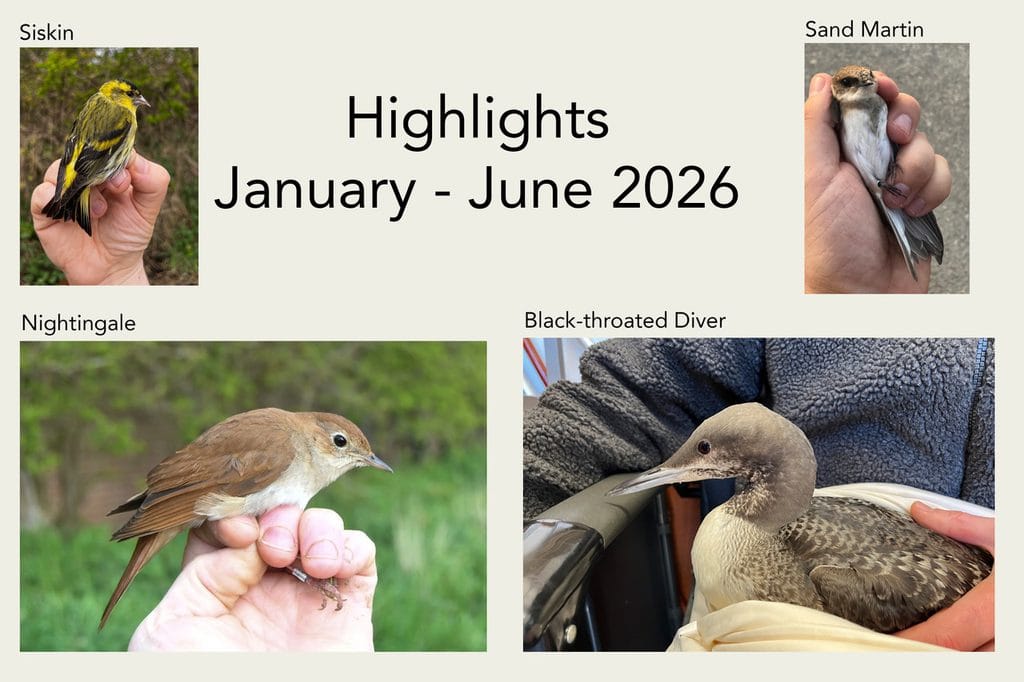
A brief round up of the efforts of the FBO ringing team over the first half of the year, generally our quietest period, we are often hampered by wind and/or rain. Our ringing tends to begin in earnest around mid April when migrant birds begin to arrive, then in May we begin our CES (Constant Effort Site) ringing at Thornwick.
Over the six month period we caught a total of 1460 birds of which 1060 were newly ringed and 400 were re-traps, with the team running 146 sessions at 8 different sites. Highlights being:
| 1 | Black-throated Diver |
| 1 | Nightingale |
| 395 | Starling |
| 52 | Chiffchaff |
| 37 | Blackcap |
| 26 | Lesser Whitethroat |
| 21 | Whitethroat |
| 7 | Willow Warbler |
| 7 | Reed Warbler |
| 6 | Sedge Warbler |
| 3 | Grey Partridge |
| 1 | Siskin |
The stand out bird being the Black-throated Diver, a juvenile bird which landed on a small pool and was then seen attempting to take off multiple times. Due to the small size of the pool there was not the room for the bird to be successful and the bird was seen to tire because of this the decision was made by the Observatory in conjunction with the land owner to attempt to capture the bird. The bird was soon caught by the ringing team, who then ringed the bird and released it safely on to the sea at South Landing. A wonderful chance to appreciate a very special bird up close and help it on its way.
A close second was a Nightingale caught in a village garden! Aged as a bird born last year, Nightingales are a rare migrant at Flamborough with only two being ringed prior to this bird.
By the end of June the team completed six CES sessions at Thornwick with a total of 124 birds caught. We are noticing a decrease in numbers at this site, something the team will be analysing at the end of the season. A pair of nesting Sparrowhawk within the site are definitely not helping…
In June we start ringing regularly in the reeded roost site at Thornwick, we mainly target hirundines and warblers.
This year we are taking part in a project analysing the impact of chemical pollution on insectivorous birds, in particular pollutants present in birds wintering grounds. The project is focusing on Sand Martins. This is done by clipping a small section of one feather from adult Sand Martins, which is then sent to Manchester University for analysis. Hopefully data will reveal how pollutants impact the birds lifetime fitness and breeding success.
A very interesting ringing recovery in June, whilst checking Barn Owl boxes on the headland: an adult female brooding chicks was discovered to have been originally ringed as a chick in Croft Plantation, Scottish Borders. A movement of 208 km south East, Barn Owls have a usual dispersal range of 20 km so this bird has travelled much further.